After several difficult years for freight, there are signs the market is beginning to turn, but this recovery may not follow the usual playbook.
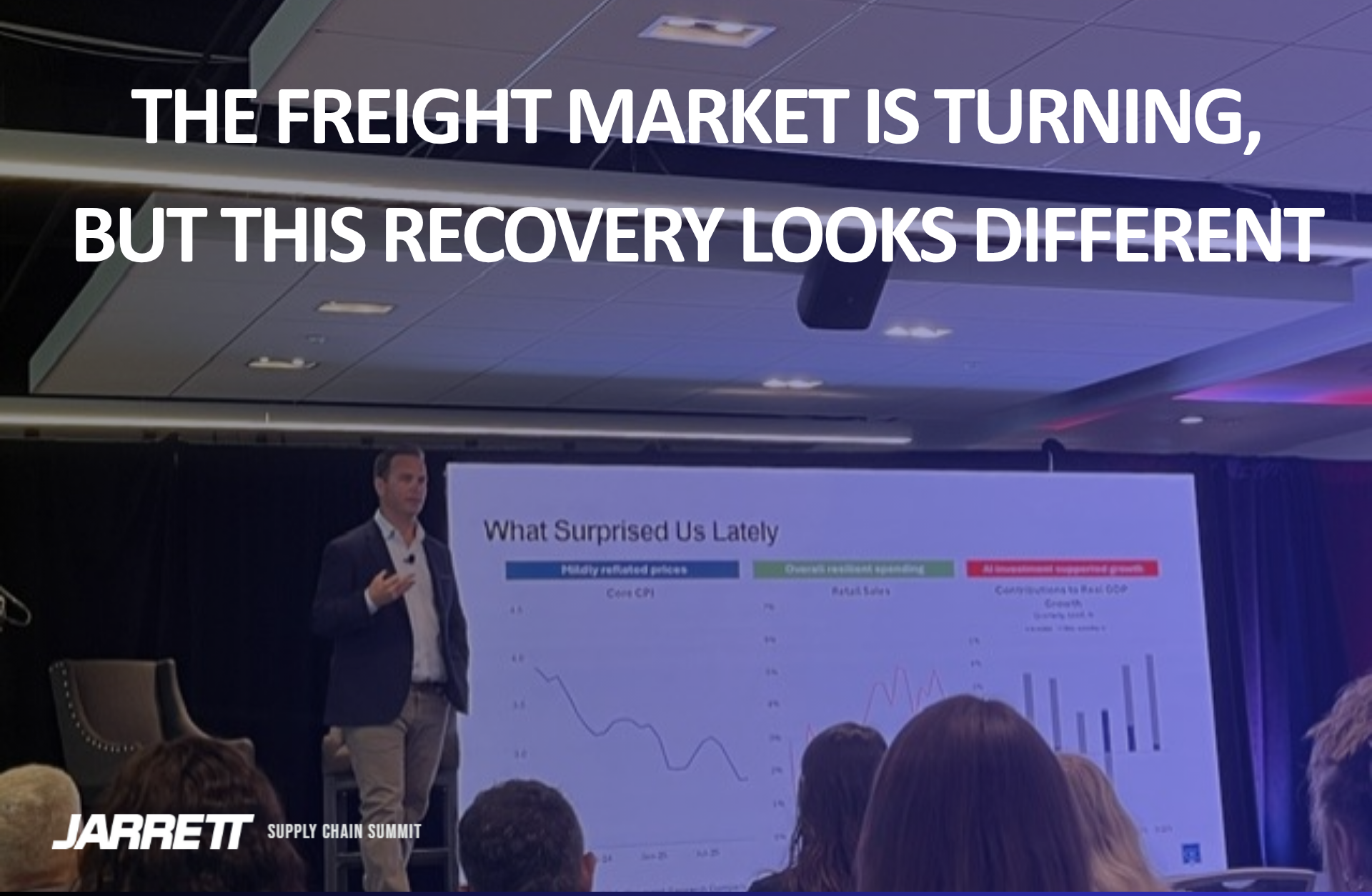
At the Jarrett Supply Chain Summit on August 6th, Chris Johnson, CFA, Senior Research Analyst at Cleveland Research Company, shared a look at where freight has been and where it may be headed through the remainder of 2026 and into 2027.
His outlook pointed to an industry moving into the early stages of recovery, but not because freight demand has suddenly come roaring back. Instead, inventory trends are beginning to shift, industrial markets are improving and capacity constraints are already affecting pricing in parts of transportation.
Why Economic Growth Hasn’t Meant Freight Growth
One of the biggest disconnects over the past few years has been between the broader economy and transportation.
Consumer spending has remained relatively resilient, and investment in AI has helped support economic growth. Yet, that hasn’t translated directly into stronger freight volumes.
Part of the explanation is where consumers are spending their money. It took six years for the mix of goods and services spending to return to pre-COVID levels after the surge in goods purchases during the pandemic.
Inflation has also meant that increases in consumer spending don't necessarily represent the same increases in the amount of goods being purchased and moved.
The result? Freight demand is still, as Cleveland Research described it, “bouncing along bottom.”
Inventory Could Be the Missing Piece
One of the more encouraging signals is what is happening with inventory.
For years, companies have managed inventory closely amid higher financing costs and economic uncertainty. Even as orders began improving, businesses continued drawing inventory down rather than immediately replacing it.
Johnson described this as passive destocking: orders are beginning to improve while inventory continues to decline. The next stage of the cycle would be active restocking, when businesses begin rebuilding inventory to keep pace with demand.
Cleveland Research now sees inventory attitudes beginning to turn, with restocking expected to become a more meaningful part of the freight recovery heading into 2027.
That could provide something the freight market has been missing: actual volume growth.
Since the Summit, new data has added support to that outlook. In its “August 2026 ISM® Manufacturing PMI® Report,” the Institute for Supply Management reported that U.S. manufacturing expanded for the eighth consecutive month. Its Customers’ Inventories Index also remained in “too low” territory, which ISM notes is generally considered a positive signal for future production.
Truckload Is Tightening Before Demand Fully Returns
Perhaps the most unusual part of this cycle is what is happening in truckload.
Normally, demand improves first. Freight volumes rise, capacity tightens, and rates follow.
This time, some of that sequence is happening in reverse.
Cleveland Research expects truckload contract pricing to increase 5–15% in 2026, excluding fuel, even as organic volume growth remains only 0–3%. The firm attributes much of that pricing pressure to capacity constraints, regulatory changes, and higher costs rather than a significant increase in freight demand.
That means transportation companies and their customers may experience higher rates before they see the kind of volume recovery that would normally accompany them.
If demand begins to accelerate while capacity remains constrained, the market could shift again quickly.
Recent truckload data also supports Johnson’s point that capacity is tightening before demand fully returns. In DAT Freight & Analytics’ August 26 report, “Dry Van Report: Rates Ease Slightly as Capacity Exits, Not Demand, Drive the Tightening,” dry van spot linehaul rates were 35.6% higher year over year while truck posts were down 28.4%. The report also cites ATA Chief Economist Bob Costello’s assessment that the recent tightening is being driven primarily by capacity leaving the market rather than freight demand returning.
The Recovery Will Look Different by Mode
There also isn't one freight recovery happening across every mode.
LTL is seeing a steadier recovery, with Cleveland Research forecasting 3–5% price increases excluding fuel and 0–3% organic volume growth. The LTL market also carries a higher mix of industrial freight, making the improving industrial cycle particularly relevant.
Intermodal is beginning to gain momentum as well. Cleveland Research sees demand growth accelerating as intermodal gains share from truckload, with pricing expected to increase 0–2% excluding fuel in 2026.
Internationally, the dynamics are different.
Ocean freight faces slow volume growth and significant additional vessel capacity, with Cleveland Research projecting capacity growth of roughly 30% over the next three to four years. Ocean pricing is expected to decline 0–10% year over year excluding fuel.
Airfreight, meanwhile, is seeing elevated pricing supported in part by AI and hyperscaler demand. Cleveland Research expects rates to remain approximately 20% higher through the second half of 2026, although normalization is expected over time.
The result is a transportation market moving in several directions at once.
What This Means Heading Into 2027
Johnson's outlook wasn't for a dramatic freight boom.
There are reasons for optimism: borrowing rates are lower than last year, AI continues to drive capital investment and productivity growth, and high-income consumers remain resilient. However, there are also headwinds, including a cooling labor market, uneven consumer conditions, lingering inflation and geopolitical risks.
The freight cycle itself is beginning to move into early recovery as capacity constraints support pricing and volume recovery starts to take hold, with inventory restocking potentially adding another source of demand into 2027.
For transportation sales and marketing professionals, the nuance matters.
“The freight market is recovering” is an easy headline, but it doesn't describe what customers are actually experiencing. Truckload, LTL, intermodal, ocean and airfreight are responding to different pressures, and the industries those customers serve are moving at different speeds, too.
Johnson's outlook suggests 2027 could bring something the industry has been waiting for: actual freight-volume growth alongside a market where capacity has already tightened. How quickly that happens remains uncertain.
For now, his analogy may be the best description of where transportation stands: the recovery looks more like a golf cart than a Ferrari: moving forward again, just not at full speed yet.
This article is based on the “State of Freight: Where We’ve Been, Where We’re Going” presentation by Chris Johnson, CFA, Senior Research Analyst at Cleveland Research Company, presented August 6, 2026.
Want more industry-specific insight like this? TMSA members get access to benchmarking data, practical resources, peer conversations and year-round education built specifically for transportation sales and marketing professionals. Learn more about TMSA membership.